What Data Should Nonprofits Collect? Overview & Top Tips
Far too many nonprofit organizations collect data without using analytics to drive success. In an increasingly data-driven world, it’s important to evaluate your nonprofit’s facts and figures. This process of data collection will allow your nonprofit to transform data into actionable knowledge.
Data collection is essential in measuring your nonprofit’s hard work. It reveals valuable insights such as how many people you serve, how best to target your supporters, and which campaigns are the most successful.
At NPOInfo, we strive to improve your fundraising efficiency using data. We’ve written this guide to give you insight into everything you need to know about data collection, including the importance of data analytics and the types of data your organization should be tracking.
We’ll cover the following points:
- Why is Data Collection Important for Nonprofits?
- 6 Types of Data That Your Nonprofit Should Be Tracking
- Nonprofit Data Collection: Top Tips
- Our Final Tip: Invest in nonprofit data append services.
When collected and managed properly, data can be an asset to your organization. Let’s dive into the benefits of data collection.

Why Is Data Collection Important For Nonprofits?
According to a study by NonprofitHub, 90% of nonprofits collect data. Nonprofits can better serve their communities with a comprehensive data collection plan, as data allows nonprofits to track trends, make informed decisions, strategize for future fundraising efforts, and more.
Most nonprofits already hold valuable information about their donors, campaigns, and marketing efforts in their constituent relationship management (CRM) systems. However, nearly half of nonprofit organizations are unsure how data can support their work.
Effective data collection can help your nonprofit:
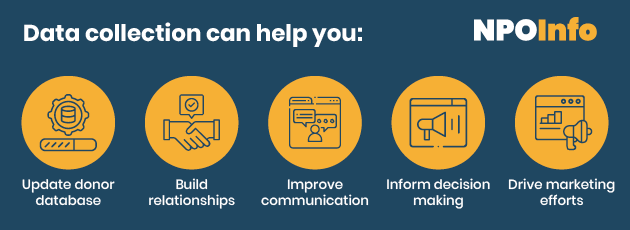
- Update your donor database. Collecting relevant donor data allows you to regularly update your donor database and, in turn, make informed decisions about your donor retention efforts.
- Build relationships. Nonprofits need to build strong relationships with their supporters to survive. With the right data, your nonprofit can personalize interactions with donors, increase engagement, and solicit donations successfully.
- Improve communication. Data empowers your nonprofit to quantify and communicate your impact to the community. This both builds your nonprofit’s credibility as a trustworthy organization to which to donate.
- Inform decision making. Make adaptive decisions based on the data that you receive. Data can answer key questions, support or refute assumptions, and assess the efficacy of campaigns.
- Drive marketing and fundraising efforts. Data-driven nonprofits are more likely to be financially successful. Use metrics to focus your nonprofit’s development efforts and boost donations.
From driving donations to informing decisions, data collection can be an asset to your organization. However, you don’t want to collect every data point available to your nonprofit— that would quickly grow overwhelming.
7 Types of Data That Your Nonprofit Should Be Tracking
Now that you understand the importance of data collection, it’s time to review the types of data that your organization should capture and analyze. As a general rule of thumb, prioritize growth by tracking data that will lead to more funding, quantify your impact, and help target areas for improvement.
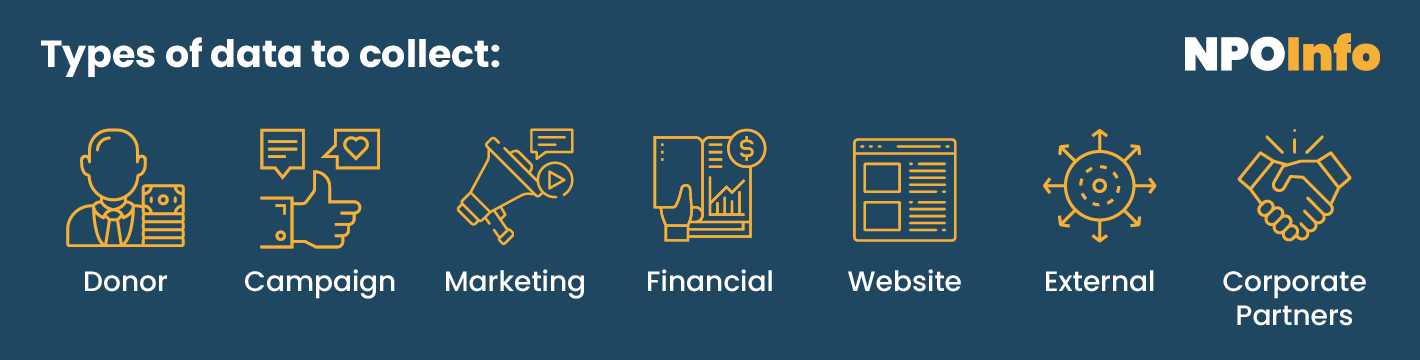
To ensure data is relevant, collect information on your donors, campaigns, marketing efforts, finances, website traffic, and mission. From mailing preferences to campaign performance metrics, these details will help your nonprofit shape engagement and retention efforts. There are countless data points that you could collect, but the following list will serve as a strong foundation for your nonprofit’s data collection process.
Donor Data
It can be difficult to strengthen donor relations without collecting or understanding your donor data.
Donor metrics reveal who your supporters are and how best to reach them. Donor data is crucial in catering to your specific audience. The data that you collect can strengthen your fundraising efforts and increase donor engagement.
To better understand your donors, start by tracking the following basic personal information:
- Name: Address donors by their preferred name and title in your solicitations to improve your chances of receiving a response.
- Age: Direct mail is the best way to reach donors of all ages, while younger supporters are more likely to respond to marketing outreach efforts on social media.
- Email Address, Phone Number, and Physical Address: Updated contact information allows for regular donation solicitations and matching gift reminders.
- Employment Status and Employer: An individual’s business affiliations can give you an idea of their net worth and potential connections. Plus, if they work for a company with a matching gift program, you can reach out to begin the gift match process.
- Educational Background: Student involvement and areas of study will reveal the causes that your donors are most likely to support.
If any of this information is missing, your organization can invest in a nonprofit data append service which will be discussed later in the guide. Once you have an idea of who your donors are, you’ll want to dig deeper to determine their motivations and propensity for giving. Consider collecting this advanced information:
- Giving History (Recurring, One-Time, Major Gift): Assess how recent a donor’s last gift was, the frequency of their giving, and the typical amount of their monetary contributions. This information can help you predict the timing and amount of future donations you will receive.
- Hobbies and Interests: Apply this information to your fundraising efforts. For example, if the majority of your donors are avid readers, host a volunteering event at the library.
- Advocacy Participation: Target potential donors that have a history of donating, volunteering, attending events, or advocating for charitable organizations more generally. Consider the organizations that your prospective donors support and focus on those whose interests align with your mission.
- Business Connections: These connections can help you leverage major gifts since donors are more likely to respond to appeals from acquaintances.
Before gathering these facts and figures, clean your donor database by removing duplicate profiles and requesting updated contact information. That way, you can more accurately identify and communicate with donors, rather than simply adding more information to a cluttered database.
Campaign Data
Chances are your nonprofit works diligently to plan and execute campaigns. Don’t let that time and energy go to waste by neglecting campaign data. This vital information can help your organization raise donations, engagement, and event attendance in future campaigns.
The following forms of campaign data will help you understand the effectiveness of your past efforts:
- Event Attendance: Events generate a lot of data. Keep track of how many people attend your virtual or in-person events as well as how many registered in advance and opened your post-event thank you emails.
- Supporter Satisfaction: Gathering feedback should be a top priority for your team. Information received through surveys can help supporters feel included and staff improve their efforts.
- Donor Acquisition Cost (DAC): DAC is the financial price you pay to convince a potential donor to make a gift. To determine this cost, sum the price of appeals and marketing efforts over a given period, and divide it by the number of donors you acquired in that time.
- Revenue: Track appeals, fundraising proceeds, matching gifts, corporate sponsorships, and online gift frequency. With this information, you can make informed decisions about your budget and strategy.
- Campaign Conversions: Measure how many people your campaign converts into first-time donors, volunteers, newsletter subscribers, or website visitors. Use these numbers to run tests on campaign efficiency and set objectives for the future.
- Donor and Volunteer Retention Rates: Donor retention rates reveal the successes and setbacks of your engagement efforts. Review this information with your team to discuss strategies for retaining donors and volunteers.
Campaign data is crucial in measuring the success of your fundraising and outreach efforts. Use these stats to identify trends across campaigns, manage your budget, and raise awareness for your mission going forward.
Marketing Data
Not only does marketing data clarify how best to reach your audiences, but it also assists in amplifying your mission and soliciting donations.
Nonprofit marketing encourages long-term relationships with donors and solidifies credibility. When marketing your mission, data analysis can be used to determine the appropriate marketing channels and engagement strategies for your nonprofit.
Let’s review the forms of marketing data that can be used to communicate your impact:
- Website Traffic: Determine how many people visit your website, how they get there, and how long they stay. This information will help you to optimize your site to receive the most traffic.
- Subscriptions: Donor retention rates increase drastically when supporters subscribe to newsletters, emails, and recurring donations. To encourage subscriptions, offer clear incentives and add pop-up forms to your website to advertise the opportunity.
- Social Media Engagement: Social media engagement can be measured through likes, shares, comments, and link clicks. Create content that encourages the most valuable engagement.
- Email Open Rates: According to MailChimp, the average open rate for nonprofit emails is 25%, meaning three quarters of your audience won’t open your emails. To increase your chances of reaching donors, write compelling subject lines, keep the frequency of your emails consistent, ensure subject matter is relevant, and send emails at an appropriate time.
To gather this information, conduct an audit on past marketing efforts using the Strengths, Weaknesses, Opportunities, and Threats (SWOT) analysis, a strategic planning technique that identifies the effectiveness of your nonprofit. To learn more about incorporating data into your marketing, check out this comprehensive guide to creating a nonprofit marketing plan.
Financial Data
Like for-profit corporations, nonprofit organizations rely on data to boost revenue and cover operating expenses. Financial data allows nonprofits to assess cash flow, maintain financial stability, and strategize budgets for future fundraising efforts. Consider the following types of data associated with accounting and budgeting:
- Expenses: From staff salaries to campaign and fundraising costs, nonprofits can easily rack up expenses. While you might be tempted to keep expenses low, it’s important to invest in your organization. In turn, you’ll see higher rates of engagement and donations.
- Income: Nonprofits can receive revenue through donations, membership fees, selling products, and more. Examine past expenses and revenue to project growth targets.
- Cash-on-hand: Cash-on-hand, or the total amount of money accessible at any given time from paper bills, bank accounts, and assets, will show how long your nonprofit can survive without donations or funding. Track cash flows to determine whether or not your nonprofit has enough revenue to cover expenses.
- Volunteer Hours: Volunteer hours reveal the labor, time, and resources needed to accomplish your goals. Log these hours to secure grants and raise awareness for your organization.
Through collecting this type of data, your nonprofit can increase return on investments and improve the quality of programs.
Website Data
Most nonprofits have a dedicated website with blog content, donation buttons, contact forms, testimonials, and more. Data analytics can be used to show which content is the most popular, determine content strategies, and create a better user experience. In order to increase traffic and prompt visitors to take action, it’s important to measure how the site performs.
If you haven’t already, start tracking these three important pieces of information:
- Traffic Sources: Potential donors can land on your site through an organic search, a referral from another site, or a redirection from social media. Once you understand how most users get to your website, you can optimize the most-trafficked referral sources to increase site visitors over time.
- Bounce Rate: This refers to the percentage of visitors who visit your site and leave, rather than continuing to view other pages or take action on your site. If your bounce rate is high, prioritize updating your web pages to provide a better user experience.
- Click-Through Rate (CTR): CTR is the percentage of users who click on a specific link to view a blog post, email, or advertisement. If you have a low CTR, revamp your calls-to-action and tailor messages to specific supporters.
You can use website analytics tools to track these details. Google Analytics is free for nonprofits through the Google for Nonprofits program. Plus, if you venture into PPC (pay-per-click) advertising like Google Ads, you can monitor site performance with this tool and tweak your ads with ease.
If that sounds too far out of reach, turn to an expert to help out. Marketing experts and paid advertising managers know how to leverage these tools to improve your website’s performance and drive more meaningful traffic.
What it all boils down to is that website data can help you convert visitors into donors. Using that data to optimize your website will boost your online presence and raise awareness for your mission. Make sure you’re using all available resources to monitor your website’s performance.
External Data
While collecting data from your own organization is important, harnessing information from third parties helps to promote growth and productivity. External data comes from sources outside of your organization and offers information related to your organization’s mission.
External data allows nonprofits to stay updated on field-related information. Your organization can access these facts and figures through public records or private data shared by other organizations. Examples of external data include water quality, homeless populations, and census information.
Whether a national average, industry standard, or third-party idea, external data can be used to shape decision-making and communicate your impact to the public. For example, let’s say a homeless shelter serves a community in which 56% of individuals suffer from food insecurity. That statistic becomes more powerful when compared to the national average of food insecurity, which is only 10%.
From donor data to external data, your nonprofit has plenty of information to collect, which can be overwhelming. Fortunately, we’ve created a list of best practices to help you achieve the maximum value from data collection.
Sponsors and Potential Corporate Partners
Staying on top of donors’ business connections can help you identify prospects for potential corporate partnerships. However, while a major donor facilitating an introduction with a business’s leadership is helpful, successful sponsorship agreements need data to back them up.
Before meeting a potential sponsor, ensure you have the following data ready:
- Philanthropic history. If a business has shown a positive affinity to causes like yours in the past, they may be inclined to support your nonprofit this time around. Most businesses proudly promote their past philanthropic initiatives by having a dedicated page or even an entire website dedicated to their philanthropic mission and the causes they’ve contributed to. Look for these resources and press releases from nonprofit organizations similar to yours about their recent sponsors.
- Giving capacity. What is a business partner able to give? When approaching potential sponsors, you should already know what you intend to request of them. Make sure this request, whether it’s a financial donation or free or discounted services, aligns with their giving history. If you’re unsure how much a business will be willing to contribute, consider presenting sponsorship tiers with pre-set benefits and donation requirements for them to choose from.
- The success of past sponsorships. When approaching businesses, emphasize the benefits of working with your nonprofit, and when possible, back it up with data from past successful sponsorships. This might include the number of guests that attended an event that featured sponsors or positive press coverage.
Like with other types of data, keep careful records of your past deals with sponsors. Ideally, your nonprofit should ensure businesses always reach out to the same point of contact at your organization to build a relationship and provide consistency. If you experience turnover or expand your team, your records will be vital in maintaining business connections and avoiding disruptions in your ongoing sponsorships.
Nonprofit Data Collection: Top Tips
Data collection is necessary for every organization, regardless of the size of your nonprofit. There are plenty of ways to gather information, from giving histories and surveys to management software and audits. Now that you understand the importance of strong data and the different types, it’s time to devise a data collection strategy.
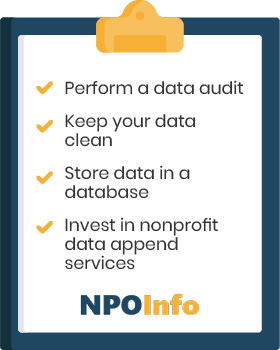
In the next sections, we’ll introduce you to the best practices for data collection. Through these tips, you will learn how to audit data, organize your information, and identify areas where you can improve. Let’s get started!
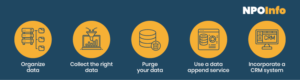
Perform a data audit.
A data audit is a critical review of your organization’s data collection process. examine the quality of your nonprofit’s current data and data collection process.
Performing an audit can help you discover areas for improvement in your database and collect data more effectively going forward. Here are the four basic steps of performing a data audit:
- Gather: Collect quantitative and quantitative data from surveys, reports, interviews, emails, and donor profiles.
- Reflect: Consider the purposes for each dataset and how it can be used to better your organization.
- Assess: Evaluate your findings to determine if you’re collecting the right data to learn about and build relationships with supporters.
- Identify: Locate areas for improvement and work with your team to devise a data-driven strategy.
During a data audit, you might notice that your data is unorganized. That’s where the next step comes into play. You’ll need to optimize your information to more easily understand it.
Keep your data clean.
Prioritizing data hygiene will help your organization to remove inaccurate and unnecessary information and standardize the data collection process. Your nonprofit should focus only on harnessing high-quality information that will help you raise donations and awareness towards your mission.
Holding onto excessive or incorrect data is a detriment to your organization, as it overshadows valuable information. Don’t waste time and money sending marketing material to people who won’t answer your calls-to-action. In order to rid your data of useless information, you should remove:
- Deceased donors.
- Duplicate profiles.
- Outdated contact information.
- People on do not call or do not mail lists.
When you eliminate this extraneous information, you’re left with a clean database containing information about attainable donors. You should also work to standardize your data, ensuring numbers, abbreviations, and mailing addresses have the same format (i.e. St. verus street).
Store data in a database.
Now that you’ve optimized your data, it’s time to store this quality information in your customer relationship management (CRM) database. With the right features, your CRM can store data, track interactions, and share information with your team. In turn, this highly organized information will strengthen and grow your mission.
Here’s a closer look at the CRM features that can benefit your nonprofit’s data management:
- Third-Party Integration: Integrate your other fundraising software directly into the CRM. That way, the CRM will function as the main database for your organization, holding the most comprehensive information.
- Real-Time Data: Automatically track personal information about your supporters and organize that data through filters. This is a far quicker process than manually inputting information into a spreadsheet.
- Data Visualization: Turn raw data into engaging visuals. Graphics and charts will help your organization tell data-driven stories.
- Mobile Access: Access your CRM on the go to ensure you always have the updated information you need to drive your mission forward.
- Searchability: Easily pull data and search for particular records using search features. This will allow you to quickly find important information.
The more functional your CRM is, the more of an asset it will be to your organization. Just make sure your database protects sensitive data like the personal information of donors and financial information. Work with your team to create protocols that implement data protection.
Our Final Tip: Invest in nonprofit data append services.
A data append is the process of adding new data points into an existing database with the goal of filling any gaps in the nonprofit’s information. Most data appending services will organize your data and set up automation for verifying it regularly. NPOInfo goes a step further.
At NPOInfo, we guarantee a high degree of accuracy in appending your donor data and ensuring your fundraising efforts are built on data you can trust. Take advantage of the following services:
- Employer Appends: Discover where your donors work to increase corporate matching gifts and deepen corporate relationships.
- Email Appends: We’ll maintain an accurate list of your donors’ email addresses, so that you can promote fundraising opportunities to supporters using correct email addresses.
- Phone Number Appends: Keep up-to-date phone numbers for regular donation solicitations and matching gift reminders.
- Date of Birth Appends: Get dates of birth to target donors in specific age brackets and improve your marketing efforts.
- Address Appends: Find out when your supporters move and update your database with accurate mailing addresses to more effectively reach your audience.
We’ll guide you through the appending process, making sure your nonprofit understands the data it’s collecting and how that information can be turned into meaningful action.
Data is power in the nonprofit sector. It allows you to attract donors, improve campaigns, and promote your mission. Collecting, analyzing, and cleaning data reveals what’s working and what’s not working in your organization.
NPOInfo’s team of experts offer services and resources to help your nonprofit organization make the most of its data. Get a quote today!
Want to continue your research on data collection or learn how to manage data more effectively? Explore these additional resources:
- Why Nonprofits Need to Utilize Donor Data Read this guide for relevant, up-to-date information on the importance of comprehensive donor data.
- 7 Strategies for Keeping Your Nonprofit Database Clean Successful fundraising depends on keeping your nonprofit donor database clean. Follow these best practices for data hygiene.
- Get to Know Your Donors Better: 4 Data-Driven Tips Understanding your donors is the key to improved fundraising and increased revenue. Read this guide for the top data-driven tips to get to know your donors.